The 20 Oldest Photographs in the World and the Stories Behind Them
Every photo in your family album, from a 1960s studio portrait in Kowloon to yesterday's phone snap, descends from a handful of experiments made in France and England in the early 1800s. Those first images took hours to expose, were often blurry and survive today only because museums guard them closely. Here are 20 of the oldest and most important photographs in existence, in roughly the order they were made, and what each one changed.
A quick timeline of early photography
1820s: Joseph Nicéphore Niépce fixes a camera image on a metal plate coated with bitumen.
1839: Louis Daguerre's daguerreotype is announced in Paris, and William Henry Fox Talbot presents his paper process in London.
1841: Talbot patents the calotype, a paper negative from which many prints can be made.
1850s: glass-plate negatives make sharper, faster photography possible and studios spread around the world.
1888: Kodak's first box camera puts photography in ordinary hands.
The 20 oldest photographs that shaped photography
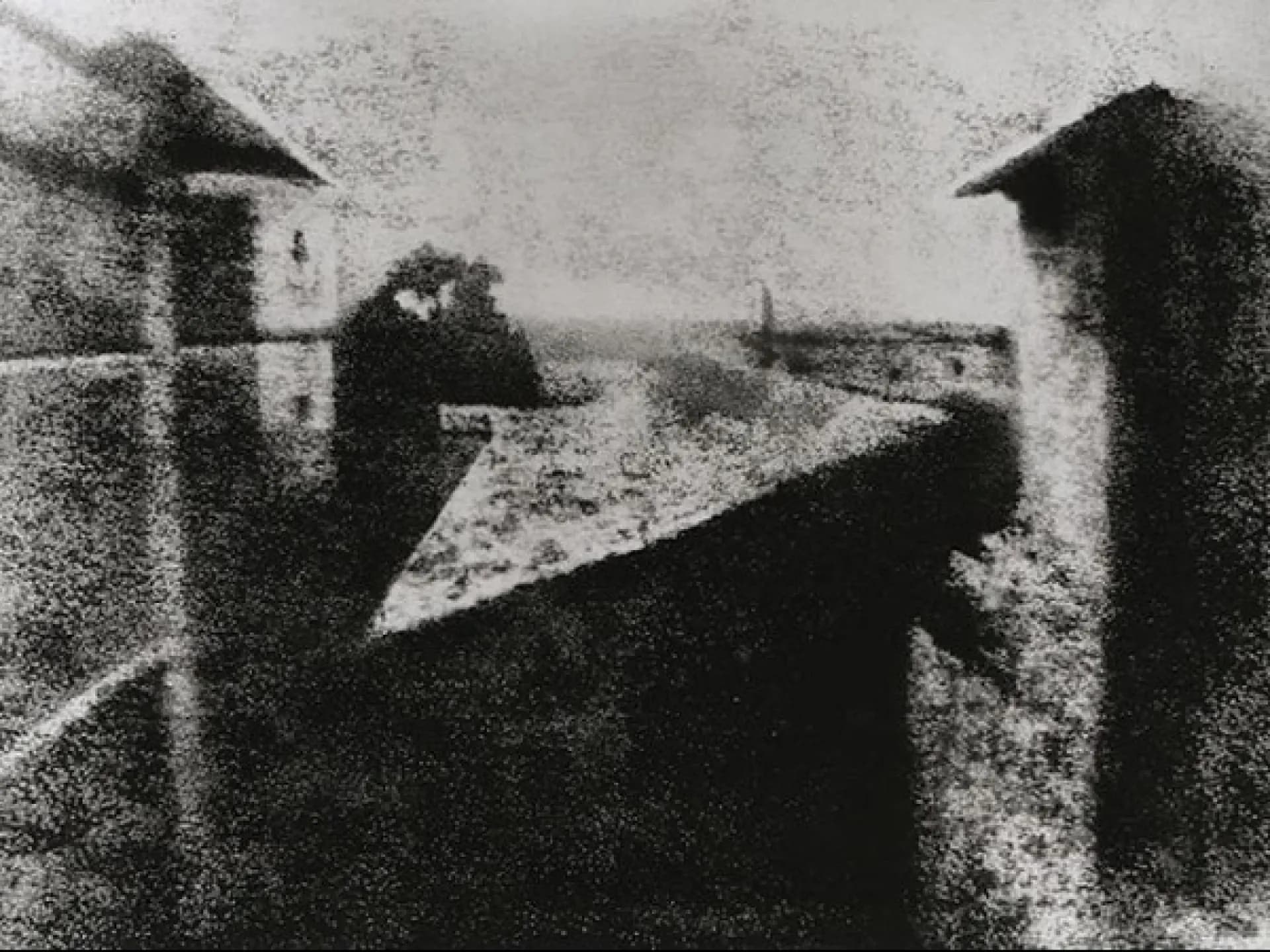
1. View from the Window at Le Gras (c. 1826–27), Nicéphore Niépce
The oldest surviving camera photograph. Niépce pointed his camera out of an upstairs window at his family estate in Burgundy and left the plate exposed for many hours, possibly days. The result is a ghostly view of rooftops and a courtyard. The plate is kept at the Harry Ransom Center in Texas.
2. The Latticed Window at Lacock Abbey (1835), William Henry Fox Talbot
A tiny paper negative of a window in Talbot's home, and the oldest camera negative known to survive. The negative-to-print idea it proved would dominate photography for the next 150 years, right up to the colour negatives many Hong Kong families still keep in shoeboxes.
3. Boulevard du Temple (1838), Louis Daguerre
A busy Paris street that appears empty, because moving carriages and walkers were too quick to register during the several-minute exposure. One figure stood still long enough to have his boots polished, and he is usually cited as the first person ever photographed.
4. Self-portrait (1839), Robert Cornelius
A young man in Philadelphia, arms folded and hair untidy, who uncovered the lens, ran into frame and sat still. It is widely described as the first photographic self-portrait, the ancestor of every selfie.
5. The Moon (1840), John William Draper
Draper, a chemist in New York, made one of the earliest photographs of the Moon using the daguerreotype process, opening the way for astronomical photography.
6. Self Portrait as a Drowned Man (1840), Hippolyte Bayard
Bayard invented his own process but felt overlooked when the French state rewarded Daguerre. In protest he staged a photo of himself as a suicide, with a bitter caption on the back. It is regarded as the first staged photograph, and an early sign that photos could tell stories that weren't true.
7. John Quincy Adams (1843), Philip Haas
A daguerreotype of the former US president, taken years after he left office. It is the earliest confirmed photograph of an American president.
8. The fishing community of Newhaven (1843–47), David Octavius Hill and Robert Adamson
This Scottish partnership used Talbot's calotype to photograph fishermen and fishwives near Edinburgh. The pictures are among the first to treat working people as subjects worth documenting, a forerunner of social documentary photography.
9. The Open Door and The Haystack (1844), William Henry Fox Talbot
Two simple scenes, a broom leaning in a doorway and a haystack with a ladder, from Talbot's book The Pencil of Nature, one of the first books illustrated with photographs. They showed that a camera could make a composed picture, not just a record.
10. Early views of China (1844), Jules Itier
A French official travelling on a trade mission made daguerreotypes in Macau and around Canton. They are often cited as among the earliest surviving photographs taken in China, decades before cameras were a common sight in the region.
11. The Sun (1845), Hippolyte Fizeau and Léon Foucault
Two French physicists managed a daguerreotype of the Sun showing sunspots. Photographing something so bright required very short exposures, a real technical achievement at the time.
12. Carte de visite portraits (1850s), André-Adolphe-Eugène Disdéri
Disdéri patented a way of taking several small portraits on a single plate in 1854. These cheap "visiting cards" turned portraits into something ordinary families could collect and swap, much like the wallet-size studio prints of later generations.
13. Jerusalem (1854), Auguste Salzmann
Salzmann photographed the walls, tombs and ancient stonework of Jerusalem in close detail for archaeological study, published in 1856. They are early examples of photography in the service of research and travel.
14. The Valley of the Shadow of Death (1855), Roger Fenton
A bare road in the Crimea scattered with cannonballs. With no soldiers in sight, it is one of the first famous images of war, and historians still debate whether Fenton moved the cannonballs for effect.
15. The Two Ways of Life (1857), Oscar Gustave Rejlander
An elaborate allegory pieced together from about 30 separate negatives. It is an early example of combination printing, the Victorian version of photo compositing.
16. Boston, as the Eagle and the Wild Goose See It (1860), James Wallace Black
Taken from a tethered hot-air balloon, this is the oldest surviving aerial photograph. The French photographer Nadar had photographed from a balloon earlier, but none of his first attempts survive.
17. The Tartan Ribbon (1861), Thomas Sutton and James Clerk Maxwell
The physicist Maxwell had proposed that any colour could be made from red, green and blue. Sutton photographed a tartan ribbon three times through coloured filters, and the images were projected together to show it in colour: the first colour photograph, and the same principle behind every phone camera sensor today.
18. Hong Kong and China (1868–72), John Thomson
The Scottish photographer ran a studio in Hong Kong and travelled widely in China, photographing streets, harbour views and people. His work, later published as Illustrations of China and Its People, is one of the best-known early photographic records of Hong Kong.
19. The Horse in Motion (1878), Eadweard Muybridge
A row of cameras fired in sequence as a horse galloped past, proving that all four hooves leave the ground at once. Muybridge's motion studies fed directly into the invention of cinema.
20. The Steerage (1907), Alfred Stieglitz
Passengers crowded on the decks of a transatlantic liner, divided into upper and lower levels. Stieglitz saw it as a pattern of shapes as much as a scene, and it is often called one of the first modernist photographs.
Why these images survived, and many didn't
Early photographs were fragile from the start. Daguerreotypes tarnish if exposed to air, paper prints fade in light, and glass plates crack. Many pioneers' images were lost to fire, poor storage or simple neglect, which is why some "firsts" above are only the first to survive. The ones we still have owe their survival to collectors and conservators who controlled light, temperature and humidity, and who now digitise them so that the public can study the image without handling the original.
The same lesson applies to family photos. Prints from the 1960s to the 1990s are much younger than these, but in a humid Hong Kong flat they can fade, yellow and grow mould within a few decades. A good digital copy is the simplest way to make sure the picture outlives the paper.
Preserve your own family history
Capture HK scans photos and complete albums in Hong Kong. Photos stuck in albums or frames are captured in place with patented 8-layer glare removal, and our Gold and Diamond plans add colour restoration to faded prints. Find out more on our photo digitisation page.
Loading...